THIS BLOG HAS MOVED


This blog has moved to a new location.


You can now read it on BKWine Magazine.


Please change your bookmarks and RSS feeds accordingly.


And do subscribe to our free wine newsletter, the BKWine Brief!


All info on our wine and food tours are now on BKWineTours.com.


Lafite and (much) more at auction in Denmark

>> Thursday, December 02, 2010

Not only Chateau Lafite-Rothschild but also many other fine and exclusive wine will be on sale at the Bruun Rasmussen auction (# 817) on December 9. Very timely they have quite a collection of Lafite on the cover of the catalogue (as well as at the auction) and there is a Lafite 1900 on sale (est. 2000-2700 euro). But there is also a wide range of other luxury wines: all 1er GCC, Guigal’s top cuvees, grands crus from Burgundy, “various” DRCs, Gaja, Krug etc etc. However, there are probably not many “bargains” to be found, but perhaps it’s not the season. For more info www.bruun-rasmussen.dk

Read more...

Christmas gift tip (?): Auction records in profusion: Cheval Blanc 1947 for $300,000 or three Lafite 1869 for £437,000

It’s almost as if there is inflation in auction price records. The press releases come in almost every day on new, stunning auction prices. Much of it seems to be driven by the incredible demand for extremely exclusive wines in Asia. Two new records were broken within just a few weeks. First out was Sotheby’s in Hong Kong with the highest price for a single lot and the (then) highest price per bottle: three bottles of Château Lafite-Rothschild 1869 sold for £437,900 (HK$5,445,000 or €534,941). Several other lots of Lafite were sold far above what was expected. Read more on decanter.com

The per-bottle record did not last long though. In came a report from Christie’s in Geneva where they had sold a single bottle of Château Cheval Blanc 1947 for $304,375 (€ 219,994) which then was the new highest price paid for a bottle. To be fair, the bottle was big, an imperial containing 6 litres, so the old Lafite was still more expensive per litre… Here is also the top-ten lots at the Geneva auction:

- Château Cheval-Blanc -- Vintage 1947, 1 imperial € 219,994
- Château Cheval-Blanc -- Vintage 1947, 1 jeroboam € 169,510
- A vertical of Château Mouton-Rothschild from vintages 1945 to 2007, 64 bottles € 97,468
- Château Cheval-Blanc -- Vintage 1947, 1 marie-jeanne € 80,517
- Hermitage, La Chapelle -- Vintage 1961, 2 magnums € 80,517
- Château Lafite Rothschild -- Vintage 1982, 12 bottles € 63,566
- Romanée-Conti -- Vintage 2005, 6 bottles € 63,566
- Château Cheval-Blanc -- Vintage 1947, 1 magnum € 44,072

It is jaw-dropping prices but perhaps not too unexpected. Certainly nothing to get upset about (unless you had a bottle and dropped it). apparently there are buyers who think it worth these prices and it is after all much less than what is paid for some pieces of jewellery or cars.

Read more...

BKWine TV wine videos viewed 200,000 times

BKWine TV recently passed 200,000 “total upload views” on YouTube. BKWine TV is our ‘channel’ on YouTube with interviews, reportage and other videos that we’ve done during our various wine tours and travel. In other words 203,366 is the number of times someone has watched a BKWine TV video. Fantastic, we’re very happy! You can find all our wine videos here on BKWine TV. (And we cannot help being a little bit extra proud that we actually have more views than Decanter Magazine – 189,737 views – but we are of course trailing far behind Wine Library TV with 1,135,197 views.)

Read more...

World champion wine videos

>> Wednesday, December 01, 2010

Andreas Larsson, sommelier world champion, has become involved in many different projects since he won his title a few years ago. The latest we’ve seen is video wine tasting notes. Andreas tastes a wine and tells you what he thinks about it – on video. The people behind the project are the same who make Tasted Magazine, where Andreas also is a collaborator. There are more than 600 wine videos with Andreas they say (not sure about that though – if you search for “Bordeaux” there are only 20 results). But still, one has to have a fair bit of luck if the wine you are interested in should be on their list. The videos will also be used at the wine department of the two French supermarket chains Carrefour and Leclerc on interactive screens. Watch Andreas’ videos here: http://www.video-sommeliers.com

Read more...

Best Wine Book of 2010 – and the winner is BKWine! (more info)

>> Tuesday, November 30, 2010

This is what we wrote in our press release about this prestigious award:

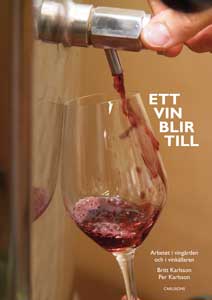
“A Wine is Born: the work in the vineyard and in the wine cellar” won the category “best drinks book”, a category that includes books on wine, spirits and beer (and thus also “best wine book of the year”) awarded by the “Måltidsakademien”, whose aim it is to promote knowledge and education on food and drink. The book is written by Britt Karlsson and photography is by Per Karlsson, both active members of FIJEV and the Circle of Wine Writers. The book explains how vines are grown in the vineyard and how wine is made in the cellar. The target audience is both the dedicated wine lover as well as wine trade professionals and students. More information on the book can be found here: http://ettvinblirtill.wordpress.com/english/

“A Wine is Born” is published in Swedish under the title “Ett vin blir till”. It does not yet have an English publisher, but Britt and Per would certainly be very interested in discussing a potential English language edition.
The title of the book is an allusion to a ground breaking photography book, “A Child is Born”, by the Swedish scientific medical photographer Lennart Nilsson first published in 1965 (www.lennartnilsson.com).

Each year ”Måltidsakademien” (http://akademierna.se/) awards prizes to the best Swedish literature in the areas of food, wine and drinks. The drink literature prize (including wine) is one of the most contested categories with a large number of entrants. In total there are around thirty categories, two of which touch wine: the Drinks Literature prize and the Combining Food and Wine category. The former included this year around 20 competing books and the latter two books.

The jury motivated its selection of ”A Wine is Born” with the following: “A detailed, in depth and very illustrative voyage through vineyards and wine cellars, where each explanation of facts and working methods invites the reader to go on his own discovery amongst growers, harvesters and oenologists”.

Britt and Per comment on the award: “We are very happy and proud. The book is the condensed result of all the vineyard and winery visits we do on our wine tours with BKWine and of the innumerable discussions we have had with winemakers. We wanted to do a book based on what’s done in real life and not just on theories; a book that is entertaining for the wine enthusiast but also educational. ‘A Wine is Born’ can even be used as a text book for wine students. In addition to the basics (and not so basics) of wine growing and winemaking we also wanted to explain things that are usually not talked about in other wine books, tools, technologies and methods, and also illustrate everything with a lot of photos, sometimes quite unique illustrations.”

Britt and Per Karlsson write about wine and produces photography on wine in their company BKWine AB. They are also a wine tour operator, organising some 30 wine tours each year, as well as consultants and wine educators.

Facts on the book:
• “A Wine is Born, the work in the vineyard and in the wine cellar”, original title “Ett vin blir till, arbetet i vingården och i vinkällaren”;
• Text: Britt Karlsson with contributions by Per Karlsson;
• Photography: Per Karlsson;
• Published by Carlsson Bokförlag, Stockholm 2009.
• Hardback, 297 pages, lavishly illustrated in colour. ISBN: 978 91 7331 270 7

BKWine: http://www.bkwine.com
Carlsson Bokförlag: http://www.carlssonbokforlag.se/
On the award: http://www.hellefors.se/kommun/booktown/start.asp
Photos on the book: http://ettvinblirtill.wordpress.com/press/pressbilder/

Read more...

Åsa's wine of the month: Taso, Valpolicella Superiore, Villa Bellini

Quiet please! Cecilia at Villa Bellini has gone from making a wide range of wines to now only making two different cuvees. One which is her Valpolicella Superiore and one Recioto di Valpolicella. Taso, which is the Valpolicella Sup (Taso means “I am quiet” in the local dialect) is made partially from dried grapes (appassimento) and the rest of the grapes are vinified directly after the harvest. It is aged for around two years in big oak casks. It is quite powerful with a good structure but without the jammy tones that an amarone often has. It has a good fruit without giving a sweet impression in the mouth. Many nuances to be found both on the palate and on the nose. An interesting wine that gives you pleasant surprises. Goes well with meat and dishes with a lot of flavour. Price: around 24 euro. www.villabellini.com

Read more...

BKWine Restaurant Pick: Bistrot le 7, Epernay

Bistrot le 7, Epernay

Epernay is a small town in the middle of the Champagne district. Here you’ll find big houses like Moët & Chandon and Mercier och many others along the beautiful, recently renovated Avenue du Champagne. And, as always in France, you also find good restaurants. One of our favourites is Bistro le 7 in the town centre, not far from Moët & Chandon. The bistro belongs to the Hotel Les Berceaux. They also have a more elegant restaurant, but personally we prefer the bistro. You get a starter for between 12 and 18 euro, for instance a lobster salad, a terrine de foie gras or snails with polenta with garlic cream. Main courses are between 18 and 26 euro and a delicious one is the grilled scallops (Noix de Saint-Jacques), with a creamy curry sauce and basmati rice. We advice you to book your table in advance.

Click here for address and more recommendations.

Read more...

BKWine Pick: Stellekaya, Stellenbosch, South Africa

>> Monday, November 29, 2010

Stellekaya, Stellenbosch, South Africa

Stellekaya is one of the wine producers that impressed us most during our trip to South Africa earlier this year. It’s a small producer – they call themselves boutique wine producer – and the wines are not only of high quality but also interesting and with a lot a character. Their winemaker Ntsiki Biyela started to work for Stellekaya in 2004 after finishing her studies in oenology at the University of Stellenbosch and her wines have won several prestigious awards. Ntsiki is originally from Kwazulu-Natal, a region where wine is not made nor drunk. She got a scholarship to study at the university in Stellenbosch and when she started she hadn’t tasted one single glass of wine. But it didn’t take long to develop a passion for red wine! We recommend all her wines. Two favourites of ours are Boschetto, the entry level wine made from cabernet sauvignon, merlot, shiraz and sangiovese with fresh fruits and a touch of minerality, and Hercules, an elegant and complex wine and yet easy-to-drink with a lot of freshness.

Also!: Watch our interview with the winemaker at Stellekaya, Ntsiki Biyela, on BKWine TV!

Click here for address and more recommendations.

Read about more recommended producers on the site: Favourite Producers

Enhanced by Zemanta

Read more...

What do people say about a wine tour with BKWine?

That is of course a question that we think is very important. We want it to be a wonderful and memorable experience for everyone. Here are some of the comments we’ve had from customers this season:

  • “Many thanks for a fantastic trip. You are so keen to make everything the best for your guests and you are so knowledgeable about wine. A pleasure to travel with you.”, W-A

  • ”Thank you for a wonderful trip to Umbria and southern Tuscany. Wonderful in many ways – our initial ideas for the trip on food and wine in Umbria and Tuscany – and discovering sagrantino and sangiovese – were more than fulfilled”, I & P in Umbria and Tuscany

  • “After last year’s fantastic trip to Champagne, Chablis and Burgundy our expectations were set very high. But this trip to Bordeaux was even better than we had hoped for. What lunches! What dinners we had! And what wonderful and personal wineries and chateaux we visited. We hope to come back on a new tour with BKWine!” A-M & S in Bordeaux

  • ”You surpassed all the expectations that we had on the tour before we came. The organisation was without a glitch and the tastings was far beyond any similar things we’ve been to previously. It whet our appetite and we already look forward to our next tour!”, B & T in the Rhône Valley

Read more...

New Brief out: Welcome to the BKWine Brief nr 88, November 2010

>> Friday, November 26, 2010

We were, to say the very least, very surprised when we opened the envelope and read the letter: We had won the prize for the best wine book in Sweden in 2010! We were the winners of the category “drinks literature” which includes wine, beer and spirits. So we quickly had to reschedule for a trip to the rural village of Grythyttan, where the Swedish Restaurant University is located – where the prize ceremony was to take place.

So it has been an eventful year indeed. Best one book of the year in Sweden. On the list of “world’s best wine tours” from Travel & Leisure, the world’s biggest travel magazine, as we told you about in the last issue of the Brief. Fantastic, we think!

Apart from that, this has been a very busy season for us. We have been to all over France (it feels like), to Italy five times from the heel to the knee (?), to Austria (for the wine bloggers conference), to Spain, to Portugal, to Greece… and of course to Sweden (to pick up the prize).

Someone asked us “what’s your favourite travel destination?” It’s a question that is as difficult to answer as “what’s your favourite wine?” And the answer will probably be the same: It is the next tour / the next wine to taste. It’s always exciting to discover something new, and even if you go to a place where you have been before you’ll discover something new.

As with many other things it is the “big and famous” that are most popular – with wines and wine travel destinations too. Sometimes we actually think it is a bit of a pity that wine tour travellers are not a bit more adventurous. Our tours to, say, Tuscany, Bordeaux or Champagne are often well filled. but some other, lesser known districts are harder to attract travellers to.

At this time of the year we are planning and discussing ideas for next autumn’s program and we have plenty of more or less far flung projects on the table. What would you say about a wine tour to Croatia? Greece? Southern Italy with Campania and Apulia – or perhaps Sicily? What about Jura up by the Alps? Or some of the other wine districts that we occasionally put on our program but are not among the best known: the Douro Valley, Languedoc, Austria etc…

One unusual “destination” that we have already decided on for next year is an “organic” wine tour! It is a wine tour to the southern Rhône Valley where all the producers we visit are working organically in one way or another: “standard” organic, biodynamic and perhaps culture raisonnée. At the moment this tour is in Swedish only but if there is demand for an English version we’d love to do that too.

So, what kind of wine tour would tempt you? Let us know. Write us an email!

According to all food and wine magazines we have now changed our wine drinking to “winter wines”. God forbid if you bring out a crisp and refreshing riesling at the end of November! No, it must be a heavy and powerful red, since that’s what goes well with hearty stews and game. (Actually, just as a protest against convention – last night we had a grenache-based Rhone wine with our Rascasse fish with fresh green beans. Excellent match!) In reality we do eat quite a lot of other things than stews and game in the autumn. We’re not big fans of compartmentalising food and drink in that way. Actually, autumn and winter is the perfect season for fish and seafood. Now is the best time to have it. And, in spite of our Rascasse-grenache suggestion, we rarely take out a heavy red with the shellfish. It is more likely to be that riesling. And it will probably also be a nice contrast to all that port you will be drinking over Christmas.

So why all this talk about riesling? Well, Britt just came back from Germany and she returned from a weekend in Munich without having tasted a single German wine! OK, Munich is not the centre of a wine district, but still. German wines were most conspicuous by their absence on the wine lists in the restaurants! The waiters suggested port or Austrian beerenauslese for dessert. Certainly not a German wine! What’s happening in Germany? Are they not proud of their wines?

Britt & Per

PS: Recommend to your friends to read the Brief or forward it to them !

Read all of the BKWine Briefe here, and why not subscribe!

More on wine:
Guest writers on BKWine.com
Wine videos: BKWine TV
Wine photography


Read more...

World’s biggest cooper: Seguin Moreau (part 3 of 3): the taste

>> Sunday, November 14, 2010

We had the occasion recently to taste a selection of wines that had “seen” wood in different ways. The most remarkable comparison was between two glasses of white wine: the original wine, or rather the original must was the same. One had been fermented in big wooden oak vats and the other had been fermented in stainless steel. After the (relatively short) fermentation they hade been aged in an identical way. The only difference was the material in the fermentation vat. The difference was remarkable. We will be coming back to this issue at a later time.

More info: www.lejournalduvin.com and www.seguin-moreau.fr and on their blog ”Winemakers for Good Wood”!

Enhanced by Zemanta

Read more...

World’s biggest cooper: Seguin Moreau (part 2 of 3): technology and quality

>> Saturday, November 13, 2010

Seguin Moreau considers itself to be a pioneer in terms of technical innovation and quality control for barrel making. they were one of the first to stop specifying the origin of the oak of the barrels. Traditionally it is often specified from which forest the oak comes in a barrel. For example: the Vosges, the Alliers, or Limousin. Seguin Moreau says that what’s important is not the origin but the quality of the oak (mainly the porosity, or the ‘grain’). And the quality varies very much for the same forest. Therefore they have stopped naming the origin and instead they give a quality indication of the wood.

This is, by the way, also something that Radoux started doing some time back.

Around 550,000 barrels – normally measuring 225 or 228 litres – are made each year in France, out of 800,000 in the world (wine barrels). Seguin Moreau makes around 75,000 barrels (barriques, pièces) per year.

A barrel costs around 600 euro. In other words, if a winemaker uses 100% new barrels every year it represents a cost of around 2 euro per bottle. The cost of the wood for one barrel is around 300 euro. Only one quarter of the wood from a trunk of an oak tree, cut down and cleaned, can be used to make a barrel.

More info: www.lejournalduvin.com and www.seguin-moreau.fr and on their blog ”Winemakers for Good Wood”!

Enhanced by Zemanta

Read more...

World’s biggest cooper: Seguin Moreau (part 1): The Oeneo Group

>> Friday, November 12, 2010

If you want to be exact, the world’s biggest cooper brand, for barrels from French oak, is Seguin Moreau. There are bigger barrel makers, e.g. making barrels for bourbon. We recently had the opportunity to visit Seguin Moreau at their headquarters just outside the small town of Cognac and will have the occasion to come back on this subject later. (We are hearing rumours about a “revolutionary” new innovation in oak barrel quality control to be launched early next year…) But we wanted to give you a few short facts about the cooper and cooperage already now.

Seguin Moreau is part of the group Oeneo, quoted on the French stock exchange. Oeneo also owns another barrel maker, Radoux, and a cork producer called Diams (perhaps better known under its previous name Sabaté, which they have changed perhaps due to an innovative process they originated that eliminates TCA in cork).

The two coopers, Seguin Moreau and Radoux, operate quite independently, even if they are part of the same group. They even seem to compete quite ferociously against each other sometimes. More info: www.lejournalduvin.com and www.seguin-moreau.fr and on their blog ”Winemakers for Good Wood”!

(Part 2 and 3 to come)

Enhanced by Zemanta

Read more...

Organic products grow with 50% at the Swedish alcohol monopoly

>> Thursday, November 11, 2010

Systembolaget, Sweden’s retail monopoly for alcohol, reports an increase in sales of 50% for organic products, including wine, for the third quarter 2010 compared to Q3-09. What the increase is for wine only is not reported. The total market share of organic products at the retail monopoly is 3%.

Systembolaget carries 117 organic products in their product range (“the fixed range”). They do not specify how many (or few) of those are wines. “To respond to (customer’s) demand we will continue to develop and broaden the range (of organic products) in the future”, says Marie Nygren, purchasing director at Systembolaget according to their press release.

But perhaps the conclusion should be the opposite? that they should suspend all organic products? The monopoly has as one objective to minimise alcohol sales (or at least not increase sales). It’s not easy to be a monopoly…

Sales of wine grew with 2.6% compared to Q3-09 to reach 49 million litres.

(NB: Organic wine is short for wine made from organically grown grapes. The EU recently failed to reach an agreement on regulations for organic winemaking. Today there are only rules for organic farming e.g. vine growing.)

Enhanced by Zemanta

Read more...

The Chinese wine market: a specialists’ blog

>> Monday, November 08, 2010

Many wine producers are betting the future on the Chinese wine market these days. The export sales to most countries are weak, but China seems to have caught an appetite for wine. According to the latest figures, if they are correct, China is now the biggest export market for Bordeaux wine, ahead of the UK. For those who want to know more about China and about how wine is sold and understood in China there is now a very specialised blog in that very subject. It is written by a Chinese journalist living in France, Jia Peng, so it is in French, but with Google Translate most people will be able to understand the essentials: Le Marché du Vin en Chine.

Enhanced by Zemanta

Read more...

Food photography festival in Paris 29 Oct – 14 Nov

The International Festival of Culinary Photography (Festival International de la Photographie Culinaire) will take place for the second year in a row in Paris between Oct 29 and Nov 14. This year’s theme is “I went down in my garden”. Definitely and interesting destination if you happen to be in Paris in the coming weeks! More info http://www.festivalphotoculinaire.com/

Read more...

French wine TV relocates to Luxemburg

>> Sunday, November 07, 2010

Edonys is the cryptic name of a new television channel that will be entirely dedicated to programs about wine. The channel was created about a year ago by an entrepreneur who has specialised in creating very niche focused TV channels. But Edonys has now received a definitive “no” from the CSA (the French authority who supervises media and television. Trivia: the head of the CSA is also a vineyard owner): Edonys will not be allowed to carry advertising for wine. And without advertising the business will of course not be sustainable. Result: The channel will relocate to Luxemburg (currently they have their offices a stone’s throw from BKWine!), and will start transmitting from there. According to the Edonys management it poses no regulatory problem to locate the channel in Luxemburg and transmit to other EU countries (the CSA is of a different opinion). Vive l’UE! They expect to start transmitting programs early 2011. More info www.vitisphere.com (and the photo?)

Enhanced by Zemanta

Read more...

Cognac Renault acquired by Altia from Pernod Ricard for € 10 M

>> Friday, November 05, 2010

Cognac Renault is a brand that is mainly known on the Scandinavian market. Best known is the premium brand Renault Carte Noire, popularly called Black Renault. Altia Corporation, controlled by the Finnish state, has acquired the brand and some stock from Pernod Ricard for 10 million euro. (The acquisition is pending approval from authorities.) We are guessing that it is one of the brands that landed in the Pernod Ricard portfolio when they bought V&S Vin & Sprit from the Swedish government some years back. The main purpose of that acquisition was to get the control of Absolut Vodka. And that this sale is another step in cleaning up the portfolio from various brands and products that came with the acquisition. Altia has already previously taken of some such brands from Pernod Ricard. Read more www.decanter.com

Enhanced by Zemanta

Read more...

New Cru Bourgeois ”stamp” launched (4): Chateau la Tour de By renounces the Cru Bourgeois label

>> Thursday, November 04, 2010

The first reaction among the producers to the new Cru Bourgeois label has come quickly. According to a press release from Chateau la Tour de By (www.la-tour-de-by.com) they have been give the Cru Bourgeois stamp for their 2008 vintage (and they were classified as Cru Bourgeois Supérieur in 2002) but they have decided to renounce from using it and have chosen to (at least temporarily) leave l’Alliance.

Frédéric Le Clerc, who runs the chateau since 2005, says that the Cru Bourgeois label “no longer corresponds to a real quality”. In his view, the new system pushes the wine producers to produce wines that do not reflect a traditional respect for terroir. Instead it benefits producers of exceptionally concentrated and oaked wines that are not typical for the Médoc region. He sees it as something that will push the wine towards a uniform international style. Chateau la Tour de By is indeed a property with a good reputation and that they renounce the new system is interesting. What will the reaction be from the other producers? Already earlier this year some other producers pulled out (www.decanter.com)
Enhanced by Zemanta

Read more...

New Cru Bourgeois ”stamp” launched (3): and the winners in 2008 are…

>> Wednesday, November 03, 2010

The very first promotion of Cru Bourgeois labels have just been awarded – for the 2008 vintage. 290 chateaux were candidates but only 243 chateaux (84%) were passed the tests and the tasting. The whole list can be found on www.crus-bourgeois.com (but it is difficult to find and quite impossible to read – the site has a very slick design but is hopeless to navigate and information is difficult to find).

247 chateaux were in the 2003 Cru Bourgeois classification. Of those only 166 have the new CB stamp. The 243 chateaux who have been given the right to use the Cru Bourgeois denomination for the vintage 2008 (that label didn’t flow easily, did it?) represent all in all 44% of the 7200 hectares in the Médoc. In other words, CB is just under half of all the Medoc.

According to their site they had 270 members in the “Alliance” (that’s what the organisation is called: l’Alliance Cru Bourgeois) in 2009. How that fits with the 290 candidates for the CB label we do not know. Have twenty already left the Alliance?

What is your view on all this? Good or bad? If you’re a wine consumer or a wine producer, we’re interested in your view!

More info www.crus-bourgeois.com

Enhanced by Zemanta

Read more...
The blog has moved. Here is the new location: BKWine Magazine Blog.

  © Blogger template Webnolia by Ourblogtemplates.com 2009

Back to TOP